
What would make you decide to leave your home and spend up to nine months in an Ecovillage in Finland? Talking to the other ESC volunteers I realized that it’s often the wish for change of pace that made them come here, the desire to get away from the dull everyday life, old routines and habits. The need to live closer to nature, far off from the structures and dictates of society. I think it’s something many people can relate to, this pursuit of a slower life. So let me address this topic of “slow living” from my point of view – living in Kurki Ecovillage.
In the recent years, slow living has become a kind of trend on social media. No wonder, in a time of worldwide crises, climate catastrophes, capitalist machinery, consumerism and constantly being online. So, it seems like a reasonable urge to escape into slower approaches to the aspects of everyday life. Luckily there are a lot of resources to be found on the internet that provide ideas for implementing slowness into your life; I believe you’ve come across this endless supply of Instagram Reels and YouTube full of tips and tricks. At the same time, the slow living movement – like all internet phenomena – can put a lot of pressure on you. Often, there is so much input, so much you NEED to do, that you get burnt out in the very attempt of preventing it. Back in Germany, this discrepancy was one of the reasons, why I felt unsatisfied with my way of life. Kurki Ecovillage is my attempt to connect to slowness, nature and myself, in a mindful and intuitive way.
So, what can slow living mean if you don’t follow a ten-step YouTube tutorial? Let me share my personal experiences of the first few months since coming to Kurki Ecovillage. With this, I don’t mean to provide another “how to”-instruction but hope to spread some inspiration.
With growing up, studying and working in Germany, I come from a background of constant productivity. I love to put my energy and passion into my work, but at the same time, a lot of it felt meaningless in the face of global crises. While studying for my university degree there was hardly a minute of rest and I often doubted the purpose of my studies, only to be released into the working world without the prospects of a home that I can pay for, enough time to actually live my life and not wasting time at a job, or even a safe future without capitalism and climate crisis ruining our planet – and so on … I think you can relate. I was longing for a different way of life, living in a community instead of lonely, finding a way to do my bit and care for the planet, slowing down.
I think I found what I wanted. Volunteer work in Kurki Ecovillage has, in fact, been slow. It is very much connected to the seasons. You could even say nature is dictating our work and the amount of energy we have to put into it. In the beginning there was a lot of weeding to be done. Weeding can be quite boring, I admit, but at the same time the repetitive work is grounding. You don’t need to think too much, it’s just one dandelion at a time. Sometimes I was very annoyed by it, but then I remembered that it actually had the purpose of providing good soil and strong plants for the food that we will eat later in the year. This is an important point, I think, to know why and what you’re doing it for.
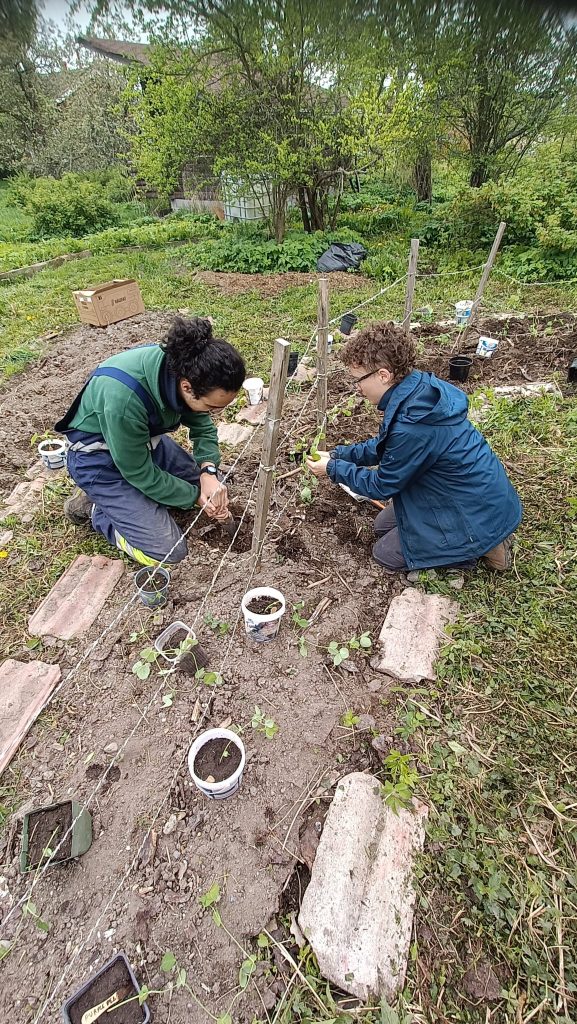
There were also new routines to be learned, especially with caretaking tasks. Heating the sauna, taking care of the toilets, these were tasks I first had to get used to. But it’s interesting how comfortable I feel with it now. So, caretaking is another routine that gives stability and repetition to life here.
Seasonal work provides so many new experiences. While the summer progresses, new plants keep appearing, first the leaves of our beet roots, then the berries, the herbs, mushrooms, veggies and just now I started collecting seeds. Picking, foraging and working with these plants is a good way to connect to nature. It also teaches patience, as sometimes a plant is just not yet ready. But this work also showed me, that you don’t need a Finnish Ecovillage or even a garden to do seasonal work. Even a walk through your local neighbourhood can be a chance for a slow approach to nature’s gifts. There is so much to be found!
So, volunteer work here is very far away from my life before with mainly office-like uni stuff. I’ve learned a lot and all in all the work here is immensely chill.
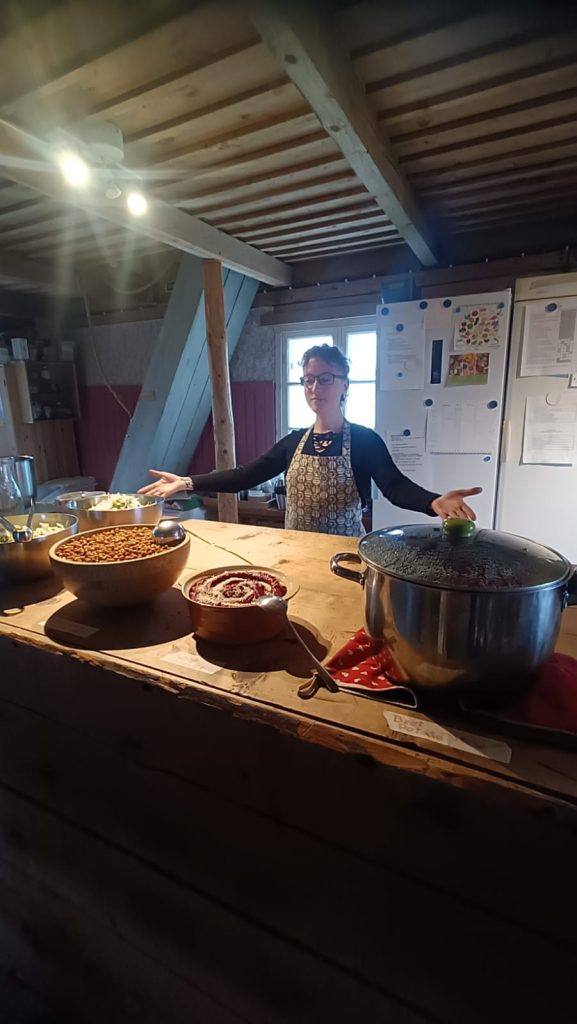
A challenge, for sure, is being in charge of community lunch. Since we are only working with seasonal veggies, adaptability is needed. I remember that we only had potatoes, carrots and beet roots in the beginning. In the kitchen, plans can change quickly according to the availability of ingredients and the allergies and diets of the people, so it provides a good opportunity to practice calmness and acceptance.
After the working hours are done, we are free to do whatever we want. But I think, this is the point, where the real challenge begins. My hustling mind is putting a lot of pressure on me to use my free time as good as I can. There are so many ideas and plans and things I want to try, which is good of course, but I also sense the productivity mindset taking over, criticising the part of me that just wants to dilly dally, slow down and relax for once. There is limited time and I would love to do so much, learn as much as I can, and I get stressed and feel pressured just thinking about it.
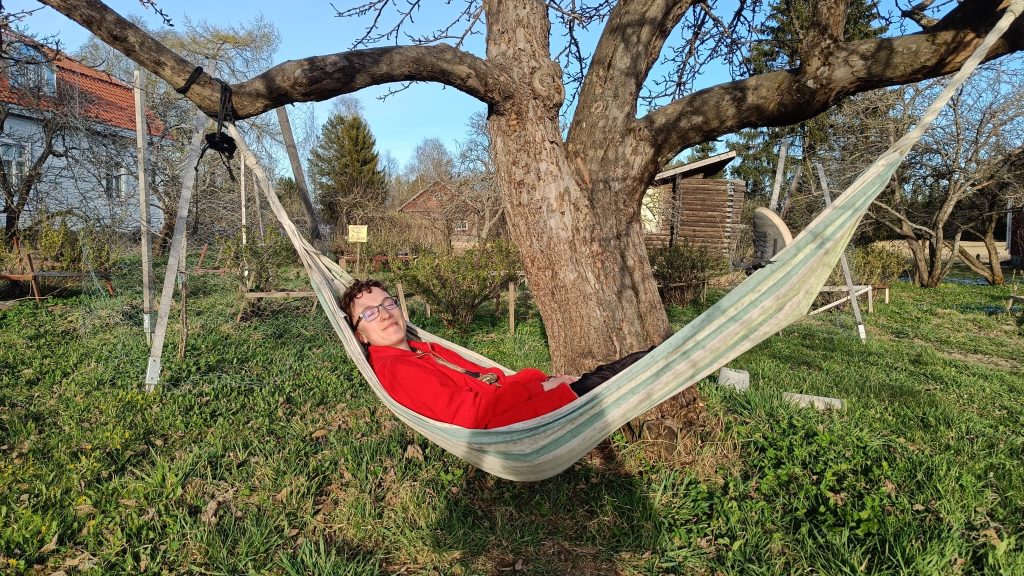
What I found has helped me are lists. Writing down all these ideas (I want to paint a picture, I want to go on a hike, I want to do sports, I want to try this new recipe …) takes them out of my mind. After that I can try to use my intuition and reflect: Do I really want to do this or am I forcing it on me because it’s supposed to be good. I am a fan of routines, and I would love to have the same schedule every week. But living so closely together with other people, having shifting levels of energy, changes in the weather, and so on, it is just impossible to follow the same routine every week. And I’ve come to realise that it’s actually good. If at any point I don’t feel like daily workout anymore, that is completely fine. But that’s something I had to learn first. So now I try to ask myself: What do I really want to do in my free time? If it’s just sitting in the hammock and listening to music, that will be completely fine. F*** productivity and hustle culture. Or, with the words of my fellow volunteer Milan: “You’re not wasting time, you’re exploring.”
Another thing, that I experience, is a certain detachment from daily news and global politics. I rarely watch the news and if I’m being honest, I have no clue what is going on in the world right now, and I often wonder, if this is a bad thing. I do care about our planet, the people, political decisions and changes, but then it’s mainly just depressing to follow the news. So, maybe it’s a good thing to disconnect for a while, focus on myself, and not give a damn about the rest of the world. Let’s be real, usually it’s always the same stuff with wars, climate catastrophes, failing socialism … So I allow myself to take a step back, let this planet circle through space, and trust that if anything majorly happens, I will somehow hear of it.
Now, halfway through the project, I am feeling very much arrived, grounded, slow. Surely, I still struggle with hustler mindset as well as with boredom, but I’ve found some of the slowness that I wanted. I felt that other ways of life, in a community and according to permaculture principles, are possible and not out of reach. And I already know how to carry these new experiences back home and implement it into my ‘normal’ life:
Breathe in and out, be where your feet are. Drop the To-Do-list. Explore new things, recipes, plants, hobbies, sports, barefoot walking …) to feel more alive. Lie around and do nothing. Buy less, cook seasonally. Sit down with a cup of coffee and a good book. ‘Waste’ time with your friends (maybe in sauna). And if it suits you, watch a ten-step YouTube video and take from that what speaks to you.
So, have we got the change of pace we needed? I definitely have and I’m excited to see what’s yet to come and change in the following months, especially in fall and the beginning of winter.
Okay, after all this mindful talk, here’s a recipe for Finnish Nettle Soup (4 portions):
Ingrediens
- Collect as much Nettle as you can from your local surroundings (4 hands full)
- 2 Tbs Butter / vegan Butter
- 3 Tbs Flour
- 800 ml Water or Veggiebroth
- 200 ml Milk / Oatmilk
- Salt, Pepper, Nutmeg, All Spice
Steps
- Wash and blanche the nettle leaves
- Let the butter melt in a pot
- Add flour to the butter and mix
- Add the water or broth and mix quickly and well to make it smooth
- Add the nettle leaves and boil the soup for 10 minutes
- Add the milk and blend the soup well
- Make it tasty with the spices
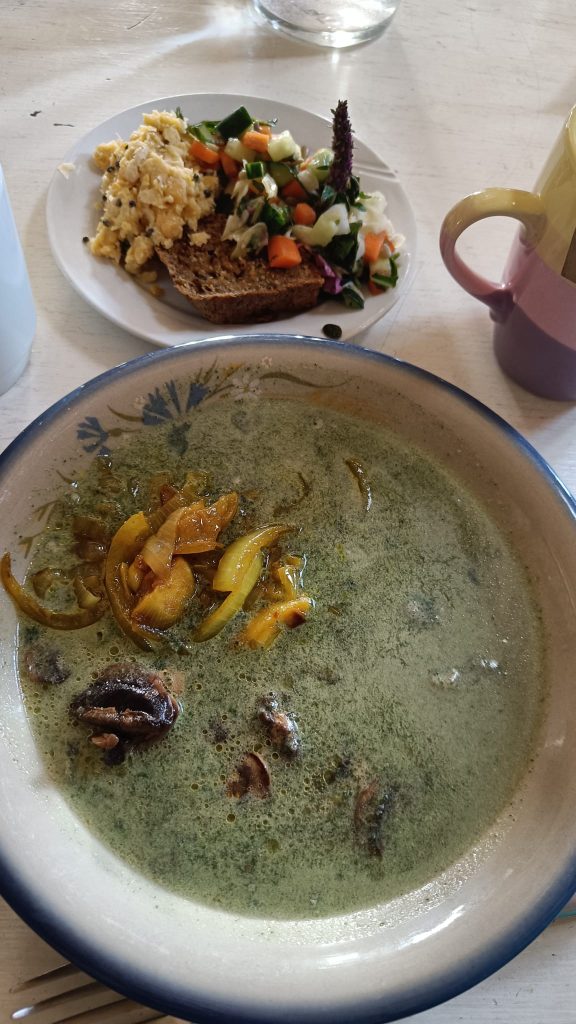
We also made a gluten-free version using coconut milk instead of the flour-butter-milk mixture. For topping we used stir fried mushrooms and caramellized onions.
Enjoy this tasty and heartwarming Finnish “soulfood”! <3
(Tune in next time for more nettle content!)